week 2 - Principles of Programming
week 2
Python

- Released in 1991
- Python is an interpreted, high-level programming language
- Used for general-purpose programming.
- Code is more readable and small amount of code is needed to express concepts compared to other programming languages.
- Saves time because of the simplicity.
First program - Hello World
print function
code:
print("Hello World")
output:
Hello World
- Use double quotes "" to print a string
Variables

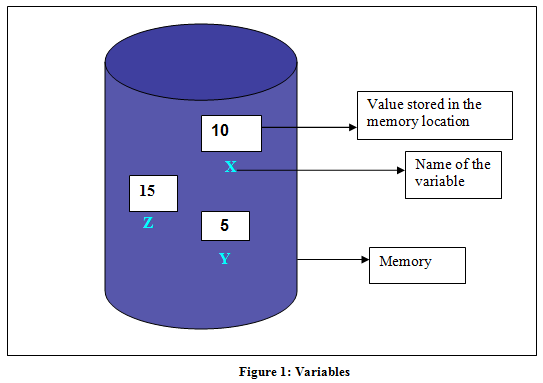
A variable is a piece of memory that stores a value that can be changed.
-
Variables are names assigned to values.
-
Think of variables as a name given to to containers that holds data.
-
In computer's memory, variable name is the reference to the memory location values are stored.
Variables in Python
Assignment operator
In Python, the primary assignment operator is the equals sign (=), which assigns the value on the right to the variable on the left.
variable <-- value
code:
message = "Hello"
print(message)
output:
Hello
Variable naming
Rules
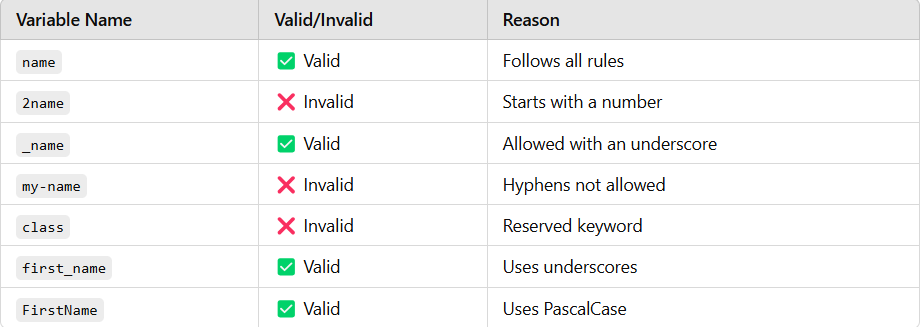
- Must begin with a letter or an underscore __ , we cannot use numbers and special symbols as the first character
- Other characters can be letters, numbers, or __ only, cannot use space and special characters
- Names are case sensitive
Name is not equal to name, these are two different variables
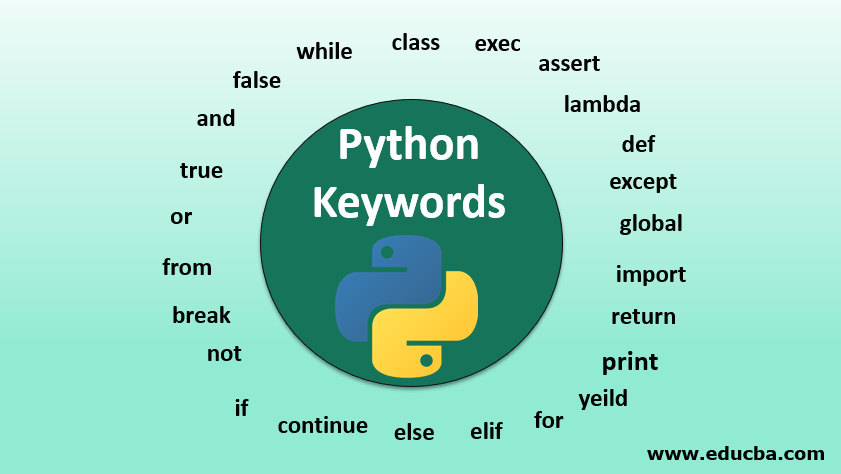
- Reserved words(key words)cannot be used as variable names.
Best practices
- Be Descriptive and Meaningful
- Generally lowercase(simple letters)
- Use Consistent Casing for multi-word naming:
- camelCase: firstName , totalAmount
- Use underscore as the delimiter( snake_case ): first_name , total_amount
- Use shorter meaningful names
Constants
A constant in programming is a named data item that holds a value which cannot be changed during the program's execution.
Constants in Python
Constant naming
- Capitalized names
- use __ for multi-word names
Examples:
ID = 2798798
MY_COUNTRY = "Sri Lanka"